Free Part 107 practice test

15 questions from the Hovertest bank, mixed like the real FAA test, with 3 on real sectional chart excerpts. Tap an answer to see if you're right, why, and the rule it comes from. No sign-up, nothing saved.

0/15 answered
Question 1 of 15Regulations

During flight you notice a propeller is cracked. What does Part 107 require?

Answer

No person may continue flight when he or she knows or has reason to know the small UAS is no longer in a condition for safe operation.

14 CFR 107.15(b) · eCFR 14 CFR part 107, current as of 2026-10-28
Question 2 of 15Airspace & charts
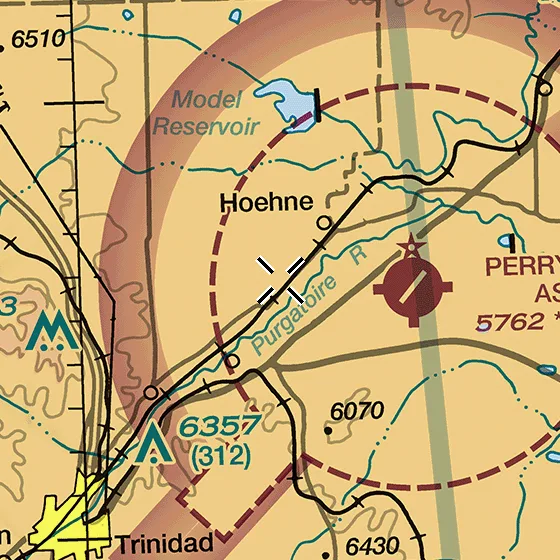
Excerpt of the FAA Denver sectional chart for question 2
FAA VFR sectional chart, Denver, edition of 2026-10-29

(Refer to the chart excerpt.) A remote pilot plans to fly at 200 ft AGL at the point marked X. Which airspace is the drone in, and is ATC authorization required?

Answer

The point lies inside the Trinidad Class E2 surface area (from the surface upward, full-time). 14 CFR 107.41 requires ATC authorization in Class B, C, D and Class E surface areas.

FAA VFR Sectional Denver (edition of 2026-10-29) · FAA Class_Airspace layer · 14 CFR 107.41

Question 3 of 15Operations

You took a medication whose label cautions against driving or operating heavy machinery. What should you do?

Answer

The FAA gives medications that caution against driving or operating heavy machinery as an example of a condition that can make a crewmember unable to perform their duties.

AC 107-2A, para 5.6.1

Question 4 of 15Regulations

Who designates the visual observer?

Answer

A visual observer is a person designated by the remote PIC to help see and avoid other traffic or objects.

14 CFR 107.3 · eCFR 14 CFR part 107, current as of 2026-10-28
Question 5 of 15Weather

What does AUTO in a METAR indicate?

Answer

AUTO means the report came from an automated source; COR identifies a corrected report.

FAA-G-8082-22, ch. 3a, METAR · FAA-G-8082-22, Remote Pilot – sUAS Study Guide (August 2016)

Question 6 of 15Regulations

Your drone weighs 0.50 lb. You attach a 0.10 lb camera. Can you fly it over people under Category 1?

Answer

The 0.55 lb limit includes everything on board or otherwise attached, so 0.50 + 0.10 = 0.60 lb is too heavy.

14 CFR 107.110(a)(1) · eCFR 14 CFR part 107, current as of 2026-10-28
Question 7 of 15Airspace & charts
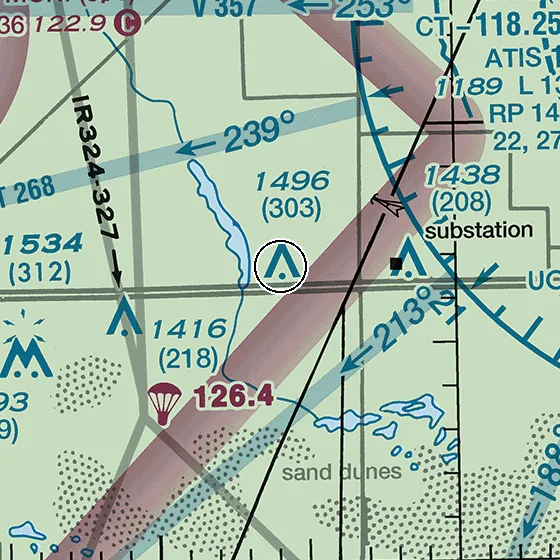
Excerpt of the FAA Seattle sectional chart for question 7
FAA VFR sectional chart, Seattle, edition of 2026-10-29

(Refer to the chart excerpt.) What is the height of the top of the circled obstacle above mean sea level?

Answer

Next to the obstacle symbol the chart prints the height of its top above mean sea level (1,496 ft), and its height above ground level in parentheses (303 ft).

FAA VFR Sectional Seattle (edition of 2026-10-29) · FAA Digital Obstacle File (OAS 53-000977)

Question 8 of 15Operations

Which can cause a lithium battery fire?

Answer

Lithium battery fires can result from short-circuit, improper charging, extreme heat, crash damage, mishandling or a defect.

AC 107-2A, para B.5

Question 9 of 15Regulations

Which element is broadcast by a standard Remote ID drone but NOT by a broadcast module?

Answer

Standard Remote ID broadcasts the control station position; broadcast modules broadcast the take-off location instead.

14 CFR 89.305 and 89.315 · eCFR 14 CFR part 89, current as of 2026-10-28

Question 10 of 15Loading

What is the load factor in a coordinated level turn at 60° of bank?

Answer

The load factor for any aircraft in a coordinated level turn at 60° bank is 2 Gs.

FAA-G-8082-22, ch. 4, Load Factors in Steep Turns · FAA-G-8082-22, Remote Pilot – sUAS Study Guide (August 2016)

Question 11 of 15Regulations

Flying a Category 1 drone from one roof inspection to the next, your straight path crosses the edge of a street festival once. Is this sustained flight over an open-air assembly?

Answer

Sustained flight over an open-air assembly in Category 1, 2 or 4 does not include a brief, one-time transit over a portion of the gathering when it is merely incidental to a point-to-point operation unrelated to the assembly.

AC 107-2A, para 8.3.2.1 · 14 CFR 107.110

Question 12 of 15Airspace & charts
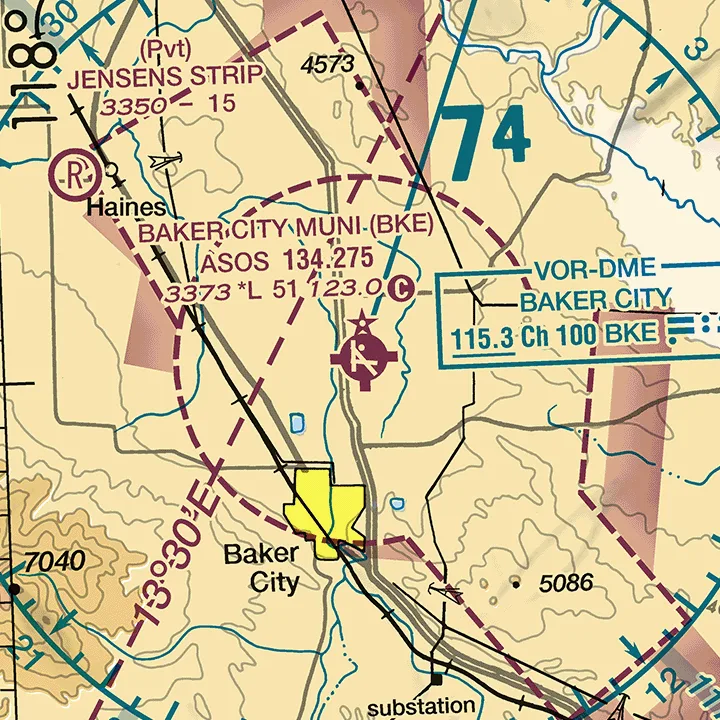
Excerpt of the FAA Seattle sectional chart for question 12
FAA VFR sectional chart, Seattle, edition of 2026-10-29

(Refer to the chart excerpt.) What is the elevation of Baker City Muni (BKE), at the centre of the excerpt?

Answer

The first figure of the airport data block is the field elevation in feet above mean sea level: 3,373 ft. The next figure, 50, is the length of the longest runway in hundreds of feet.

FAA VFR Sectional Seattle (edition of 2026-10-29) · FAA US_Airport layer · FAA Runways layer

Question 13 of 15Weather

Temperature and dew point are close together. What is likely?

Answer

When air reaches saturation with temperature and dew point close together, fog, low clouds and precipitation are highly likely.

FAA-G-8082-22, ch. 3b, Temperature/Dew Point Relationship · FAA-G-8082-22, Remote Pilot – sUAS Study Guide (August 2016)

Question 14 of 15Operations

During an in-flight emergency, you deviate from a Part 107 rule. What must you do afterward?

Answer

You may deviate to the extent necessary to meet the emergency, and must send a written report of the deviation upon request of the Administrator.

14 CFR 107.21 · eCFR 14 CFR part 107, current as of 2026-10-28

Question 15 of 15Regulations

You pass the initial knowledge test on March 10, 2026. By what date must you complete recurrent training to keep exercising the privileges of your certificate?

Answer

Recurrent training must be completed within 24 calendar months of passing the initial test. A calendar month ends on its last day, so the deadline is the end of March 2028 (in the FAA's example, a test passed on September 13, 2020 gives a deadline of September 30, 2022).

AC 107-2A, para 6.7.2 · 14 CFR 107.65

Your score 0%

The real test has 60 questions in 2 hours. Hovertest gives you 537 questions, unlimited full-length exams and a readiness score, for $24.99 once.

See Hovertest Read the Part 107 test guide